

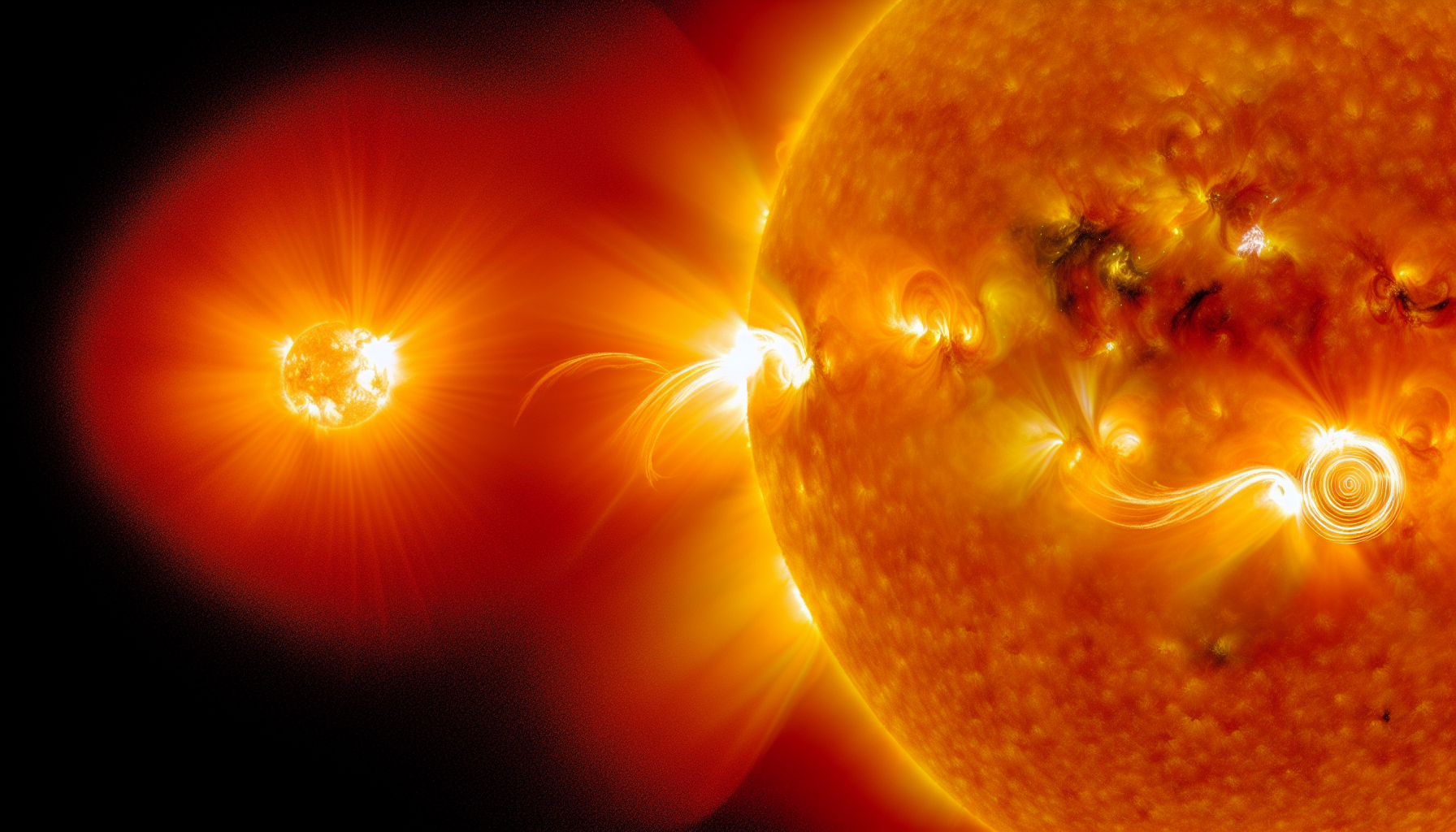
The sun has once again put on a spectacular display of activity, as an X1.4 solar flare erupted from Region 4405 on March 30, 2026. This powerful flare peaked at 0319 UTC and was accompanied by a significant coronal mass ejection (CME), which was captured in detailed coronagraph imagery. As scientists and space weather forecasters analyze the implications of this event, the potential impacts on Earth are under close scrutiny.
Understanding Solar Flares and Their Significance
Solar flares are sudden, intense bursts of radiation emanating from the sun’s surface. They occur when magnetic energy that has built up in the solar atmosphere is suddenly released. Classified into categories based on their intensity, X-class flares represent the most powerful category, with the potential to disrupt telecommunications, navigation systems, and power grids on Earth.
Region 4405, the source of this recent flare, has been under observation due to its increasing activity. Flares of this magnitude, such as the X1.4 event, are closely monitored by space weather agencies worldwide, including NASA and the National Oceanic and Atmospheric Administration (NOAA).
What Happened on March 30, 2026?
The X1.4 flare from Region 4405 was significant not only due to its intensity but also because of its timing. The flare peaked during a period when solar activity was already on the rise, suggesting that the sun may be entering a more active phase in its solar cycle. This flare released vast amounts of energy, causing a CME that was visible in various satellite images.
The CME, which is essentially a significant release of plasma and magnetic field from the sun’s corona, is expected to travel through space and could interact with Earth’s magnetosphere, leading to geomagnetic storms. Scientists are currently analyzing the trajectory of the CME to predict its potential impacts.
The Effects of Coronal Mass Ejections
CMEs can have a variety of effects on Earth, depending on their size, speed, and the orientation of their magnetic fields. Some of the common effects include: We covered NASA's new space telescope in more detail.
- Geomagnetic Storms: When CMEs collide with Earth’s magnetic field, they can create geomagnetic storms, which can disrupt satellite operations, GPS systems, and even power grids.
- Auroras: One of the more beautiful effects of CMEs is the increase in auroras, or northern and southern lights, which occur when charged particles from the solar wind interact with Earth’s atmosphere.
- Radiation Exposure: Increased radiation levels during solar storms can pose risks to astronauts and high-altitude flights.
As forecasters continue to monitor Region 4405, they are particularly focused on the potential for further flares and additional CMEs in the coming days. Solar activity tends to occur in cycles, and the emergence of such powerful flares can indicate that the sun is gearing up for even more intense activity.
Current Monitoring and Future Forecasts
Space weather agencies have dedicated teams that constantly monitor solar activity and provide real-time updates on significant events. Following the X1.4 flare, these teams are employing advanced models and instruments to track the CME and assess its impact on Earth.
While the immediate effects of this particular flare and CME are still being evaluated, scientists are also preparing for the possibility of future solar events. The solar cycle, which lasts about 11 years, is currently approaching its peak, known as solar maximum. During this phase, the frequency of solar flares and CMEs typically increases, leading to a heightened need for monitoring and preparedness.
Conclusion
The X1.4 flare from Region 4405 serves as a stark reminder of the dynamic nature of our sun and its ability to influence space weather. As the scientific community continues to analyze the event and its potential impacts, it highlights the importance of ongoing research and monitoring of solar activity. Understanding these phenomena not only aids in predicting their effects on Earth but also enhances our broader knowledge of the sun’s behavior and its influence on our planet.
As we look ahead, keeping an eye on solar activity will be crucial for mitigating risks associated with space weather, ensuring that technology and life on Earth remain protected from the sun’s powerful forces.


