

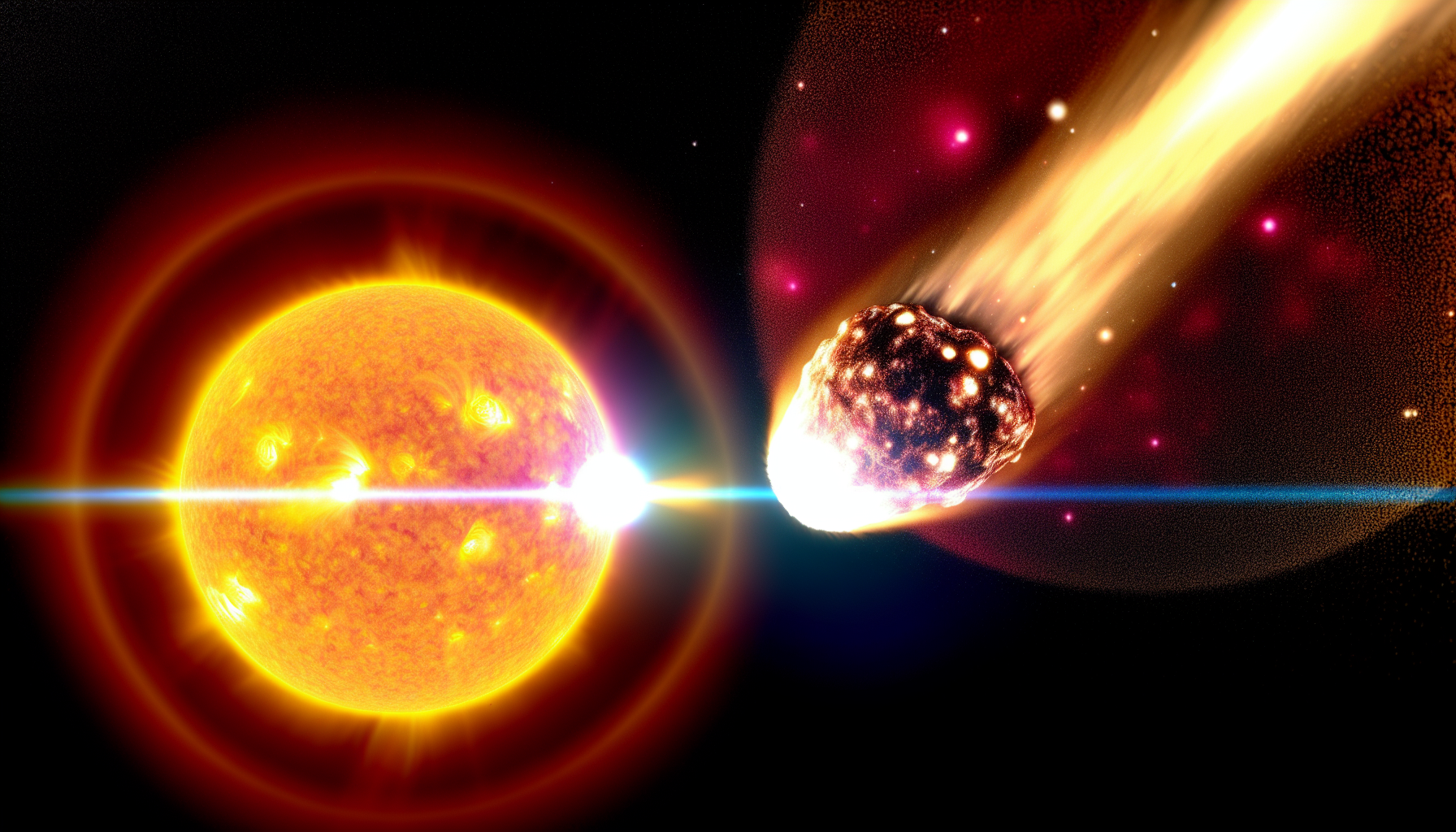
On April 4, 2026, astronomy enthusiasts and scientists alike turned their eyes toward the sun as Comet C/2026 A1 (MAPS) made an extraordinary close approach, ultimately leading to its disintegration. This remarkable event unfolded just 99,400 miles from the sun’s photosphere, surprising astronomers with its proximity—much closer than earlier estimates suggested.
Perihelion Passage and Disintegration
The moment of perihelion occurred at approximately 9:18 CDT on April 4, when the comet reached its closest point to the sun. As it neared this fiery giant, the intense solar radiation and gravitational forces began to take their toll on the fragile structure of the comet. Observations leading up to the perihelion showed the comet sporting a small tail and a diffuse green coma, a signature feature indicative of diatomic carbon (C2) emission.
Despite earlier predictions that suggested a more stable trajectory, Comet MAPS was unable to withstand the extreme conditions encountered during its sunward journey. The heat and gravitational pull from the sun proved too powerful, leading to the comet’s breakup before it could complete its pass.
Understanding Comet Composition
Comets are often described as “dirty snowballs,” composed of ice, dust, and rocky materials. When comets approach the sun, they heat up, causing the ice to vaporize and release gas and dust into space, forming a coma and tail. The green hue observed in the coma of Comet MAPS indicates the presence of diatomic carbon, a gas commonly found in the atmospheres of comets.
This emission is not only a visual spectacle but also a subject of significant scientific interest. Understanding the chemical composition of comets helps astronomers learn more about the building blocks of the early solar system and the processes that led to the formation of planets.
Upcoming Earth Encounter
Comet MAPS will make its closest approach to Earth on April 5-6, 2026, at a distance of more than 89 million miles. Although the comet has broken apart, it will still be an exciting opportunity for astronomers to observe the remnants and gather data about its composition and behavior.
The anticipated close encounter provides a unique chance for both professional astronomers and amateur stargazers to witness the aftermath of this sungrazing comet. While Comet MAPS may no longer exist in its original form, the debris left in its wake could contribute to our understanding of cometary fragmentation and evolution.
The Significance of Sungrazing Comets
Sungrazing comets, like C/2026 A1 (MAPS), pose significant interest in the field of astronomy for several reasons:
- Scientific Research: The study of sungrazing comets allows scientists to explore the effects of solar radiation on cometary bodies, revealing insights into their composition and behavior.
- Potential Meteor Showers: The debris from disintegrated comets can create meteor showers when Earth passes through their remnants, providing an opportunity for beautiful celestial displays.
- Historical Context: Sungrazing comets have been observed throughout history, and studying them helps put into context how these phenomena have influenced ancient cultures and their understanding of the cosmos.
Future Observations and Research Opportunities
The breakup of Comet MAPS presents a chance for ongoing research and observation. Astronomers are particularly interested in tracking the comet’s debris and the potential meteor activity that may result from its disintegration. As Earth passes through the remnants of MAPS, there is a possibility of a meteor shower, which could provide a spectacular show for stargazers around the globe.
Additionally, the event adds to a growing list of sungrazing comets that have met a similar fate. Each instance offers valuable data, contributing to our understanding of cometary dynamics and the solar system’s evolution.
Conclusion
While the disintegration of Comet C/2026 A1 (MAPS) during its near-sun flyby is a poignant reminder of the fragility of these celestial bodies, it also opens doors for further exploration and discovery. As scientists analyze the remnants of this comet and its impact on our planet, the story of MAPS will undoubtedly continue to unfold, enriching our understanding of the cosmos.


