

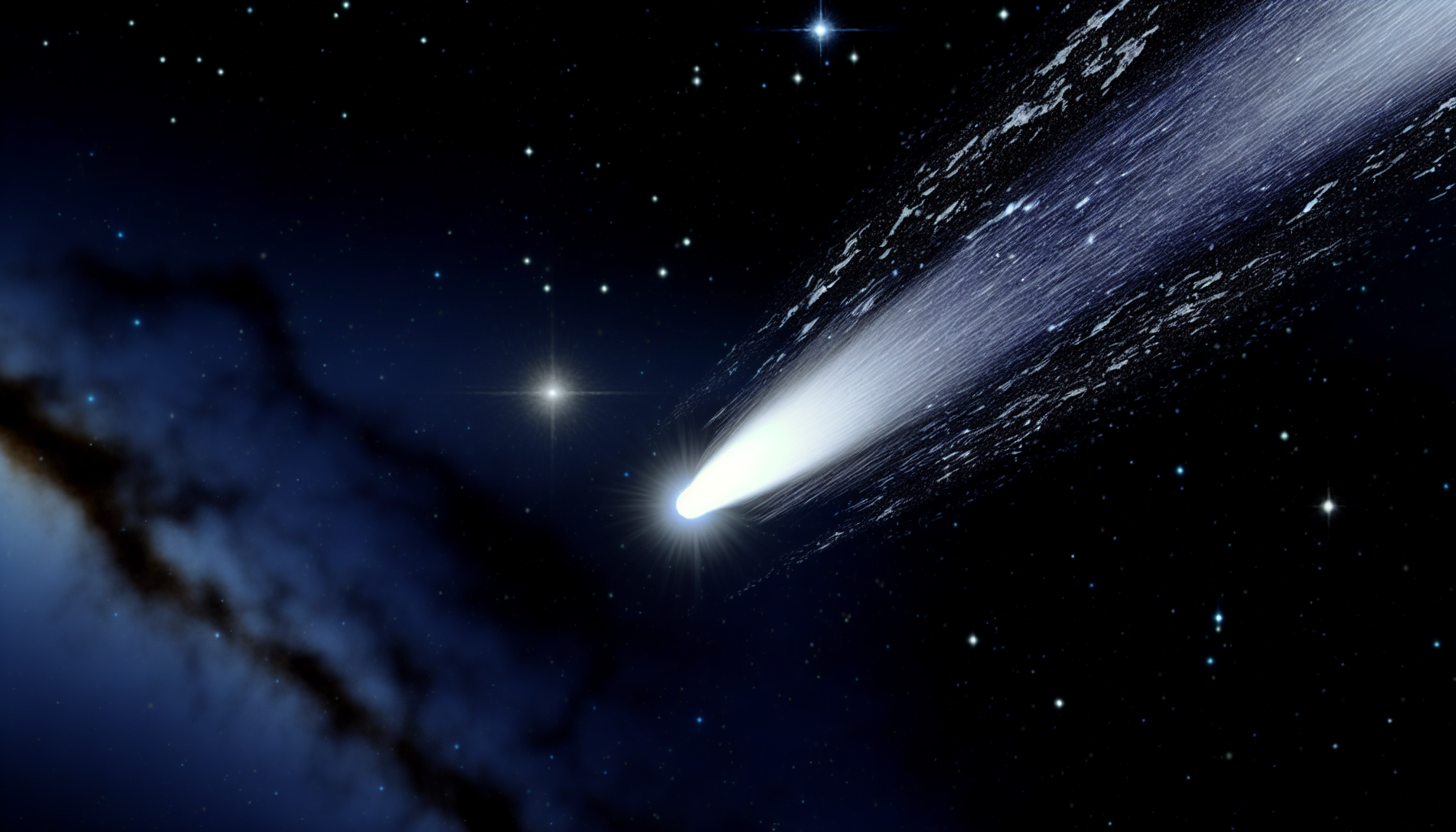
On April 3, 2026, the astronomical community was set abuzz by the release of groundbreaking footage that sheds light on an interstellar comet, designated as 2026 A1. This celestial body, believed to have originated from outside our solar system, has captivated the attention of scientists and space enthusiasts alike due to its peculiar characteristics and unexpected behavior.
Understanding 2026 A1: An Interstellar Intruder
Discovered in early 2026, the comet 2026 A1 has become a focal point for researchers worldwide. Unlike typical comets that orbit the Sun, this comet hails from the Oort Cloud, a distant, icy shell surrounding our solar system. Its trajectory suggests it passed through the solar system at a remarkable speed, allowing scientists to capture unprecedented footage with advanced imaging techniques.
Unusual Characteristics and Behavior
The recently released footage reveals several peculiarities about 2026 A1 that challenge existing models of cometary behavior. Some of the most striking observations include:
- Irregular Shape: Unlike the typical elongated, icy formations of known comets, 2026 A1 presents a more irregular and possibly fragmented shape, raising questions about its formation and history.
- Unpredictable Activity: The comet exhibits unexpected outbursts of gas and dust, which appear to be more sporadic than those of its solar system counterparts, indicating a unique composition or internal structure.
- Color Variations: The footage captures a range of colors emanating from 2026 A1, suggesting the presence of various materials that have yet to be identified.
Implications for Astronomical Research
The revelations from this comet could not only reshape our understanding of interstellar objects but also impact broader theories in astronomy. Dr. Emily Carter, an astrophysicist at the Galactic Institute, stated, “These observations could provide insights into the conditions and processes that exist in other solar systems, which could be key to understanding planetary formation and evolution.”
Furthermore, 2026 A1’s unusual behavior prompts scientists to reconsider the dynamics of cometary orbits and interactions with stellar environments. With its speed and trajectory indicating a possible close encounter with our solar system, studying this comet could help refine models of how such objects travel through space.
Capturing the Footage: Advanced Technology in Action
The footage was made possible through a collaboration between several observatories equipped with cutting-edge technology. The James Webb Space Telescope and ground-based observatories utilized advanced imaging techniques to track and capture detailed observations of 2026 A1 as it neared the Sun.
According to the European Space Agency, the data collected not only enhances our understanding of 2026 A1 but also contributes to a larger database of interstellar objects, helping researchers draw comparisons and identify trends among these celestial phenomena.
Future Research Directions
As scientists delve deeper into the mysteries surrounding 2026 A1, several research avenues are emerging:
- Composition Analysis: Future missions may focus on analyzing the comet’s surface and materials to uncover its chemical makeup, which could reveal its origins.
- Dynamic Modeling: Researchers are likely to create new models to simulate the comet’s behavior and interactions with different gravitational fields.
- Comparative Studies: Understanding 2026 A1 in relation to other interstellar objects will be crucial for building a comprehensive picture of the dynamics of our galaxy.
Public Interest and Outreach
The release of this astonishing footage has sparked widespread interest, prompting educational institutions and astronomy clubs to host discussions and viewing parties. The potential for engagement with the public is significant, as astronomy enthusiasts are eager to learn about the implications of this discovery.
Dr. Mark Johnson, a noted educator in the field of astronomy, stated, “Public engagement in such discoveries is vital. It not only fosters interest in science but also encourages future generations to pursue careers in STEM fields.”
Conclusion: A New Era of Interstellar Exploration
The interstellar comet 2026 A1 represents a remarkable opportunity for the scientific community to expand its understanding of celestial objects beyond our solar system. The recent footage, unveiling shocking secrets, is just the beginning of a journey that promises to challenge our current knowledge and inspire new generations of astronomers.
As researchers continue to analyze the data and refine their models, the implications of 2026 A1 will likely resonate throughout the field, leading to new discoveries and a deeper appreciation for the mysteries of the universe.


