

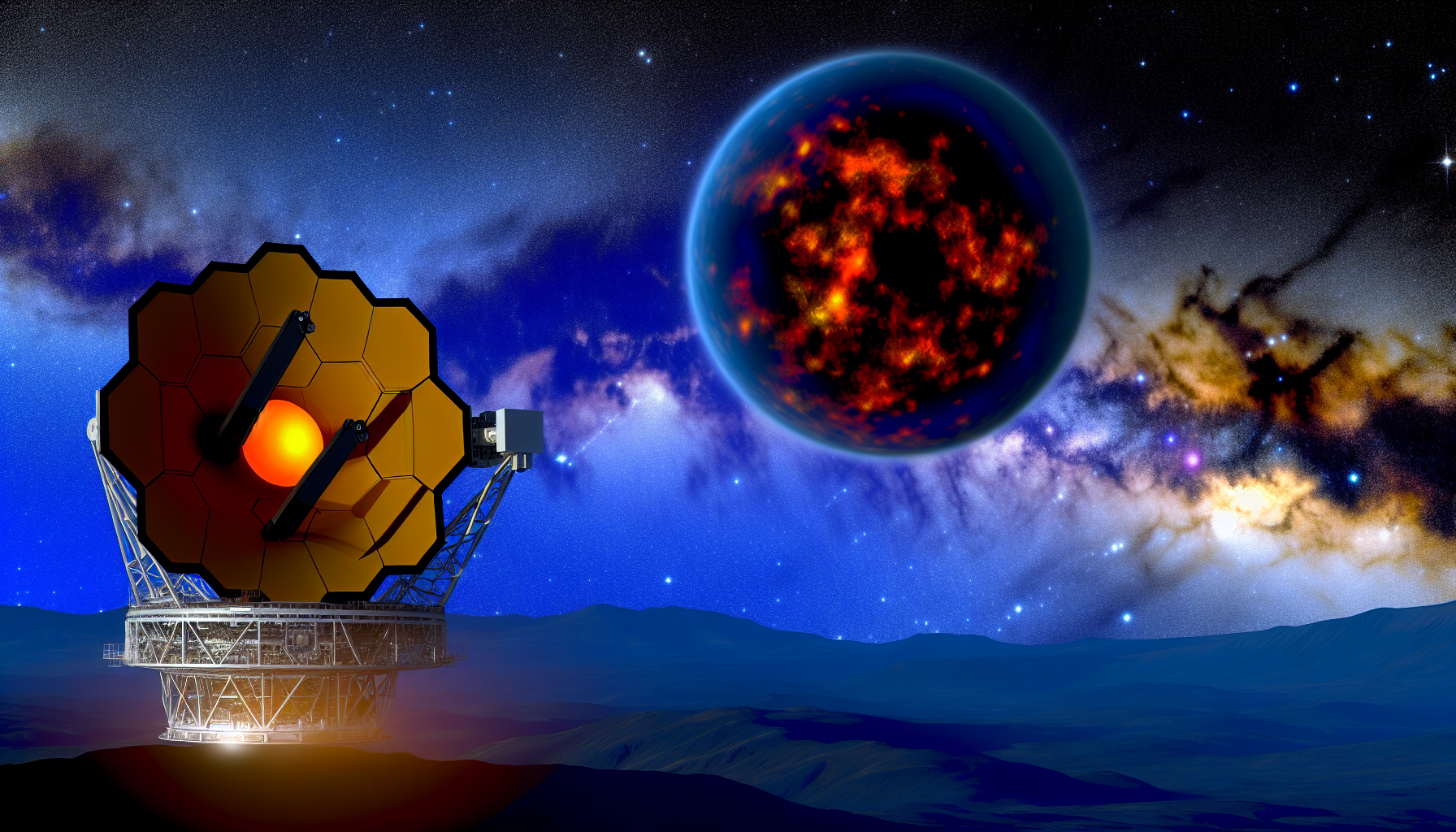
The James Webb Space Telescope (JWST) has made a groundbreaking discovery, revealing a thick and mysterious atmosphere around an ancient super-Earth exoplanet, previously labeled a ‘lava world.’ This celestial body, characterized by its scorching surface temperatures, has long been considered barren, yet recent observations have suggested that it may harbor an atmosphere that defies expectations.
The Discovery
Located outside our solar system, this super-Earth has temperatures high enough to maintain molten lava oceans. Such extreme conditions have led scientists to question the planet’s ability to hold onto an atmosphere. However, the JWST’s observations, conducted in collaboration with researchers from the Carnegie Institution, indicate that this planet may possess a thick atmosphere, challenging long-held assumptions about atmospheric retention on such hostile worlds.
What is a Super-Earth?
Super-Earths are a class of exoplanets with a mass larger than Earth’s but significantly less than that of Uranus or Neptune. These planets often orbit within their star’s habitable zone, where conditions might allow for liquid water to exist. However, many super-Earths, including the one studied by JWST, can have extreme surface conditions that make them inhospitable to life as we know it.
The Lava World
The super-Earth in question is characterized by its incredibly high surface temperatures—soaring above 1,000 degrees Celsius (1,832 degrees Fahrenheit). Under such conditions, it is likely that the planet’s surface is dominated by molten rock and lava oceans, presenting an environment that seems far from conducive to life. Yet, the detection of a significant atmosphere around this planet has opened new avenues for understanding its potential for habitability.
Atmospheric Composition and Retention
One of the most intriguing aspects of this discovery is the composition of the atmosphere itself. The JWST’s advanced capabilities allow for a detailed analysis of the atmospheric constituents, suggesting that there may be a combination of gases that contribute to its retention. Scientists speculate that processes such as volcanic outgassing may play a critical role in maintaining the atmosphere, providing a continuous source of gases despite the planet’s extreme conditions.
Volcanic Outgassing
Volcanic outgassing refers to the release of gases from the planet’s interior, which can contribute significantly to atmospheric composition. On a super-Earth ‘lava world,’ this outgassing could potentially replenish the atmosphere, preventing it from being stripped away by the intense heat and solar radiation it experiences. This process raises important questions about the geological activity of such exoplanets and their capacity to maintain atmospheres over geological timescales.
Implications for Exoplanet Habitability
The findings from the JWST challenge the prevailing notion that extreme environments like those found on super-Earths are devoid of atmospheres. The detection of a substantial atmosphere around this lava world indicates that even in the harshest conditions, planets may have the potential to retain gases that could be vital for habitability. This discovery has profound implications for our understanding of the formation and evolution of exoplanets.
New Frontiers in Exoplanet Research
As astronomers continue to explore the universe for potentially habitable exoplanets, the insights gained from the JWST’s observations will be invaluable. The ability to detect and analyze atmospheres on distant worlds opens up new possibilities for identifying planets that may support life, even in conditions previously thought to be uninhabitable.
Conclusion
The James Webb Space Telescope’s revelation of a thick atmosphere surrounding a super-Earth lava world marks a significant milestone in exoplanet research. By challenging existing assumptions about atmospheric retention under extreme conditions, this discovery not only enhances our understanding of the potential for life beyond Earth but also invites further exploration into the processes that govern planetary atmospheres. As scientists continue to analyze this data, we may soon uncover more secrets about the diverse worlds that exist in our universe.
As we look to the future, the JWST promises to be an essential tool in unraveling the mysteries of the cosmos, leading us to a deeper understanding of the conditions that foster life among the stars.


