

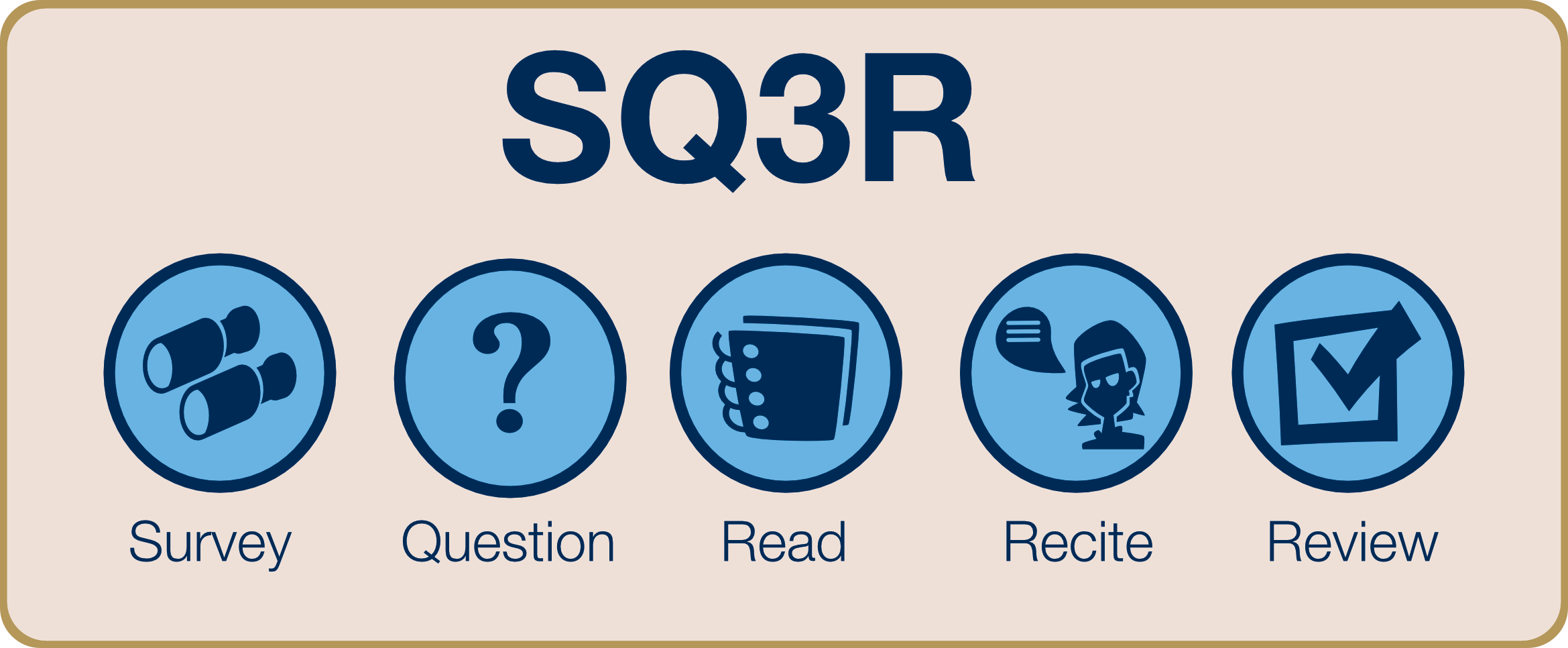
The SQ3R method is a comprehensive and effective approach to reading and studying that helps individuals better understand, retain, and recall information from written material. Developed by Francis Pleasant Robinson in his 1946 book “Effective Study,” this method has become a widely used study technique in educational settings.
SQ3R is an acronym that stands for the five steps of the reading process:
- Survey:
The first step involves quickly skimming through the material to get an overview of its content and structure. This includes:
- Reading the title, headings, and subheadings
- Looking at any graphics, charts, or illustrations
- Reading the introduction, conclusion, and summary (if available)
- Noting any bold or italicized text
This step helps create a mental framework for the information you’re about to read in detail.
- Question:
After surveying the material, the reader formulates questions based on the information gathered. This can involve:
- Turning headings and subheadings into questions
- Asking yourself what you already know about the topic
- Considering what you want to learn from the text
This step activates prior knowledge and creates a purpose for reading.
- Read:
Now, the reader goes through the material carefully, seeking answers to the questions formulated in the previous step. While reading:
- Focus on understanding the main ideas
- Look for answers to your questions
- Pay attention to details that support the main concepts
This active reading approach helps maintain focus and improves comprehension.
- Recite:
After reading a section, the reader should try to recall and summarize the main points without looking at the text. This can involve:
- Answering the questions you formulated earlier
- Explaining the concepts in your own words
- Making notes or creating mind maps
This step reinforces learning and helps identify any areas that need further review.
- Review:
The final step involves going over the material again to ensure thorough understanding and retention. This includes:
- Skimming the text again
- Reviewing your notes and summaries
- Reflecting on the main ideas and their connections
Regular reviews help move information from short-term to long-term memory.
Benefits of the SQ3R Method:
- Improves reading comprehension and retention
- Encourages active engagement with the material
- Helps identify important information more efficiently
- Enhances critical thinking skills
- Prepares readers for exams or discussions about the material
While the SQ3R method can be time-consuming, especially at first, it becomes more efficient with practice. It’s particularly useful for academic reading, complex texts, or any situation where deep understanding and retention of information is crucial.
In conclusion, the SQ3R method offers a structured approach to reading that can significantly enhance learning outcomes. By actively engaging with the text through surveying, questioning, reading, reciting, and reviewing, readers can improve their comprehension, retention, and recall of information, making it a valuable tool for students, professionals, and lifelong learners alike.


