

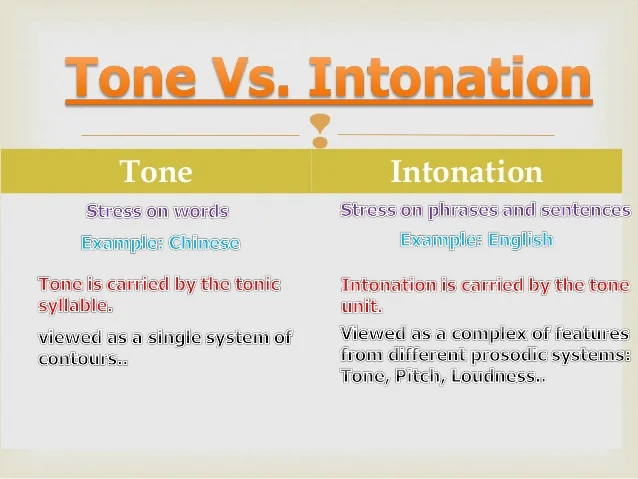
Intonation and tone are crucial elements of spoken language that convey meaning beyond the words themselves. They are part of the prosodic features of speech, which include pitch, stress, and rhythm.
Intonation refers to the rise and fall of pitch in speech. It can indicate:
- The type of sentence (e.g., statement, question, command)
- The speaker’s emotions or attitudes
- Emphasis on particular words or phrases
- Contrast or contradiction
For example, in English, a rising intonation at the end of a sentence often indicates a yes/no question, while a falling intonation typically signals a statement or command.
Tone, on the other hand, has two main meanings in linguistics:
- In non-tonal languages like English, tone refers to the speaker’s attitude or emotion conveyed through voice quality. This can include sarcasm, anger, excitement, or boredom.
- In tonal languages like Mandarin Chinese or Vietnamese, tone refers to the pitch pattern of a syllable that can change the meaning of a word. For instance, in Mandarin, the word “ma” can mean “mother,” “hemp,” “horse,” or “scold” depending on the tone used.
Both intonation and tone play crucial roles in communication:
- They help convey the speaker’s intentions and emotions
- They can clarify ambiguities in speech
- They contribute to the overall rhythm and melody of language
- They aid in turn-taking during conversations
Understanding intonation and tone is essential for language learners to communicate effectively and avoid misunderstandings. It’s also crucial for developing natural-sounding speech in a second language.
In written communication, intonation and tone are often conveyed through punctuation, word choice, and context. However, they can be more challenging to interpret accurately, which is why face-to-face or voice communication is often preferred for sensitive or nuanced conversations.


